Chittagong Hill Tracts (CHT) is a military controlled area, where all the news are filtered by the military and the Bangladeshi government.CHT, where blood has shed for decades and hopes were burnt to ashes by the brutes, constitutes of people who want their voice to be heard. We are here to ensure that the voice of these unheard victims in CHT echo around the world despite the Bangladeshi government trying to suppress them in the biased state run media.
Our email : chtnewsupdate(at)gmail.com
Ramgarh attacks: latest count says total houses burnt 95, 4 Indigenous persons are confirmed missing.
April 19, 2011
The United Peoples’ Democratic Front (UPDF) Khagrachari district unit has prepared a list the houses burnt, shops looted and persons wounded and went missing during the 17 April settler attacks on six Jumma villages in Manikchari and Ramgarh Upazilas under Khagrachari district.
According to UPDF, the number of houses burnt is 95, while 4 persons are confirmed missing.
However, it said the number of those missing could rise further.
Attacks on Jumma villages in Ramgarh and Manikchari under Khagrachari district
Total houses burnt in six villages: 95 (including a Buddhist temple), total shops looted: 4, wounded: 13 (out of about 50), confirmed missing: 4 (feared 20)
1. List of those whose houses have been burnt down in the arson attack on 17 April 2011 in Ramgarh and Manikchari under Khagrachari district:
A. Uttor (North) Shonkhola Para, number of houses burnt: 25 + a Buddhist temple
No.
Name and Father’s/husband’s name
Age
Damage in Taka (approx)
Remarks
1.
Aung Pru Marma son of late Thoa-u Khoi Marma
55
2,75,000/
2.
Thuichai Marma son of Ripruchai Marma
45
2,75,000/
3.
Nihla Aung Marma son of Konghla Pru Marma
50
2,10,000/-
4.
Do Aung Pru Marma son of Chai-u Marma
50
1,20,000/
5.
Yeohla Marma son of unknown
71
3,50,000/-
6.
Chaila Marma son of late Nichai Marma
60
3,20,000/-
7.
Uthoai Marma son of Thoai Pru Marma
48
2,90,000/-
8.
Paichari Marma son of unknown
30
3,50,000/-
9.
Tui Kra Marma wife of Tipru Mahajon
44
2,00,000/-
10.
Aungsajai Marma son of Mongtu Marma
38
1,70,000/-
11.
Mongkyojai Marma son of Mongtu Marma
30
1,80,000/-
12.
Rui-u Marma son of Hlopa Aung Marma
35
1,40,000/-
13.
Alumong Marma son of Nila Aung Marma
30
1,10,000/-
14.
Arema Marma wife of unknown
40
2,50,000/-
15.
Paicha Marma son of Ruihla Aung Marma
40
2,30,000/-
16.
Rapruchai Marma son of Do Aung Pru Marma
30
3,80,000/-
17.
Mong Pru Marma son of unknown
45
2,98,000/-
18.
Uggyo Marma son of unknown
65
2,75,000/-
19.
Chaiaung Marma son of unknown
53
2,30,000/-
20.
Aung Kyo Jai Chakma son of Chai Aung Marma
38
3,90,000/-
21.
Thoai Aungyo Marma son of Thoai Aung Pru Marma
38
3,80,000/-
22.
Apru Mong Marma son of Nila Aung Marma
30
4,00000/-
23.
Sui nu Mong Marma son of Nila Aung Marma
38
3,00000/-
24.
Rui-u Marma son of unknown
40
2, 30,000/-
25.
Paicha Aung Marma son of unknown
58
2,80,000/-
26.
Daimasukha Buddhist Temple
B. Soludong Para, number of houses burnt: 36
27.
Paicha Marma son of Aungsha Pru Marma
50
10,0000/-
28.
Thoai Pru Chai Marma son of Lapa-ung Marma
45
3,00,000/-
29.
Thuihla Aung Marma son of Sapru Marma
37
3,00,000/-
30.
Mongshajai Marma son of Hlapa Aung Marma
53
1,00,000/-
31.
Chaila Pru Marma son of Hlapa Aung Marma
58
2,00,000/-
32.
Augyojai Marma son of late Mongbai Marma
60
1,00,000/-
33.
Kongjai Marma son of Thuichai Marma
32
3,00,000/-
34.
Mongbuli Marma son of unknown
48
4,00,000/-
35.
Chuithoai Marma son of unknown
38
1,00,000/-
36.
Aung Pru Marma son of late Chokra Aung Marma
62
5,00,000/-
37.
Mong Shew Marma son of late Rui-u Marma
48
2,00,000/-
38.
Sachi Mong Marma son of unknown
42
70,000/-
39.
Ruicha Aung Marma son of Sapru Marma
34
1,00,000/-
40.
Chuibai Marma son of Thoairi Marma
30
2,00,000/-
41.
Kaj Marma son of Thoairi Marma
37
1,00,000/-
42.
Kala Marma son of unknown
42
2,50,000/-
43.
Ruihla Aung Marma son of Thui Chai Marma
36
1,00,000/-
44.
Pairui Marma son of Khilu Aung Marma
48
3,00,000/-
45.
Nila Pru Marma son of late unknown
50
2,75,000/-
46.
Mongshey Pru Marma son of Auga Pru Marma
38
1,75,000/-
47.
Thoairui Marma son of Solu Aung Marma
65
3,00,000/-
48.
Kongjai Marma son of Thuichai Marma
38
2,75,000/-
49.
Mongshey Hla Marma son of Ripru Marma
23
1,28,000/-
50.
Paihla Marma son of late Khilu Aung Marma
60
1,29,000/-
51.
Nila Aung Marma son fo Thuichai Marma
40
1,37,000/-
52.
Reda Marma son of Kongjaw Marma
30
2,00,000/-
53.
Mongshe Pru Marma son of Aungo Marma
30
2,80,000/-
54.
Bulichai Marma son of Moira Marma
45
2,80,000/-
55.
Thuihla Aung Marma son of late Nicha Aung Marma
55
2,90,000/-
56.
Ruicha-u Marma son of Thuichai Marma
30
3,00,000/-
57.
Chini Aung Marma son of Nicha Aung Marma
52
3,70,000/-
58.
Situ Marma son of Sapru Marma
52
1,68,000/-
59.
Chithoai Marma son of Aungsha Pru Marma
38
3,97,000/-
60.
Gongjaw Marma son of late Kyo Aung Marma
35
2,70,000/-
61.
Sairi Pru Marma son of Mongtak Marma
38
1,30,000/-
62.
Ula Pru Marma son of Aumpru Marma
37
4,00,000/-
C. Remrong Para, number of houses burnt: 5
63.
Uggojai Marma son of late Mong Marma
35
2,40,000/-
64.
Kongjaw Marma son of Reda Marma
45
2,20,000/-
65.
Ush Mong Marma son of late Mong Marma
32
2,50,000/-
66.
Momong Marma son of late Aungyo Marma
60
2,00,000/-
67.
Kyojaw Marma son of late Monghla Pru Marma
55
3,40,000/-
D. Toikarma Para, number of houses burnt: 9
68.
Chashey Marma son of late Modhu Marma
50
60,000/-
69.
Bhadu Marma son of Motushu Marma
42
80,000/-
70.
Thoai Aung Marma son of Motushu Marma
37
50,000/-
71.
Mongshey Marma son of late Tani Marma
36
50,000/-
72.
Kyojaw Marma son of late Kyoshai Boidyo
52
40,000/-
73.
Yumong Marma son of unknown
50
25,000/-
74.
Aungjai Marma son of unknown
60
50,000/-
75.
Rangchai Marma son of late Motu Marma
60
50,000/-
76.
Konghcai Marma son of unknown
42
50,000/-
E. Podachara, number of houses burnt: 8
77.
Mon Mohan Chakma son of late Moinya Chakma
70
5,00,000/-
78.
Kaladhan Chakma son of Shanti Kumar Chakma
52
1,50,000/-
79.
Tongo Chakma alias Jotsna son of late Kina Shankar Chakma
52
1,50,000/-
80.
Aunga Chakma son of late Jamini Chakma
45
1,00,000/-
81.
Momong Marma son of unknown
45
3,00,000/-
His motor bike was burnt down. His son Anu Marma is missing.
82.
Pathor Moni Chakma alias Bijoy son of Gongadhar Chakma
40
1,00,000/-
83.
Mon Chakma son of lage Nani Kumar Chakma
50
1,50,000/-
84.
Ula Pru Marma son of late Modhu Marma
58
2,00,000/-
F. Manikchari Mahamuni Para / Kyojai Karbari Para, number of houses burnt: 11
85.
Nainda Marma son of late Aungjairi Marma
50
300,000
86.
Mongshe Pru Marma son of Hori Chakma
42
100,000
87.
Nakra-u Marma wife of Aungyojai Marma
52
200,000
88.
Konjaw Aung Marma son of late Thoimra Aung Marma
45
500,000
89.
Mong Hla Pru Marma son of late Mongtap Marma
40
300,000
90.
Hori Marma son of late Ingkrang Marma
58
200,000
91.
Ukra Marma son of late Aungjairi Marma
66
400,000
92.
Hlakra Marma wife of late Thoi Aungyo Marma
40
200,000
93.
Kichafa Marma son of late Ingkrang Marma
52
100,000
94.
Kongchain Marma son of unknown
52
100,000
95.
Doloi Marma son of late Konghla Yo Marma
50
100,000
2. List of those whose shops were ransacked and looted in Manikchari
1.Mongshajai Marma, 45, son of Paindai Marma of village Rajpara. The settlers ransacked his shop and looted cash Taka 50,000.
2.Chaila Pru Marma, 45, son of Mongla Marma of village Rajpara.
3.Ukyoching Marma, 35, son of unknown of village Rajpara.
4.Khilu Aung Marma.
The settlers also tried to break into Rajbari Jetoban Buddhist temple, pelted stone the temple and the residence of Mong Chief with stones.
3. List of the wounded (incomplete)
1.Mitu Marma, 12, son of Kyojai Marma of village Chokyabil, Manikchari
Ula Pru Marma, 8, son of do..
Kolindra Chakma, 65, son of unknown of village Porchuram Ghat, Ramgarh
Aina Chakma, 22, wife of Thoba Chakma, village Pokkimura, Sindukchari, Mahalchari
Bulu Chakma, 17, son of Bokya Chakma village Joutha Khamar, Mahalchari
Usha Marma, 23, son of Ugyo Marma village Nakapa
Mongshey Marma, 30, son of unknown of village Raikhali, Chittagong
Ugyo Marma, 11, son of Mongshe Pru Marma, Raikhali Chittagong
Joti Ranjan Chakma, 52, son of Subhash Chakma, village Modhupur, Khagrachari
Chajai Mong Marma, son of unknown of village Manikchari
Sanio Marma, wife of Chajai Mong Marma of village Manikchari
Polen Chakma, son of Milan Kanti Chakma, village Nuopara, Dighinala
Sonamuni Chakma, 25, son of Sundor Kumar Chakma village Joi Kumar Karbari Para, Kobakhali, Dighinala
Chitra Chakma, 21, wife of Sonamuni Chakma.
4. Confirmed missing:
1.Anu Marma, 16, son of Momong Marma, village Podachara, Hafchari Union, Ramgarh
2.Ammey Marma, 27, wife of Apruchi Marma, village Bot-tola, Rameshu Bazaar, Guimara
3.Her (Ammey Marma) daughter Ukra Marma, 2.
4.Ashish Chakma, 19, son of Dev Priyo Chakma, Balukhali, Baghaichari, Rangamati (he is a third year student of Chittagong Polytechnic Institute).
A writing on tragic incident of Baghayhat (19-20 Februry 2010): which killed three Indigenous people and more than 450 Indigenous houses were burnt down on this communal attack led by the Bengali Settlers and security forces.
"Mother has passed away. We could not get her body. Because, we had to flee from our native village Guchchagram to Gangarammukh valley when a bullet all on a sudden struck her in chest. Thank God, we have found our father here who got out for work at dawn on the fateful day. Some of our relatives in the forsaken Guchchagram have cremated her," said Sumita (age: 17), Jewell (age: 16) and Rupna (age: 12), three children of Budhdhapudi Chakma (age: 36), the Jumma woman who was shot dead at an ethnic clash that took place on February 19.
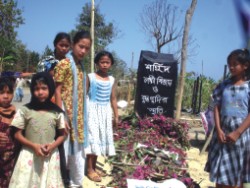
"Now, we light up thousands of candles in her memory each evening in accordance with our Budhdhist rituals," they added as standing besides a little shahid minar (dome for the martyrs) which the hill people of Baghaihat, Sajek Union of Rangamati have erected to commemorate the death of Laxmibijoy and Budhdhapudi, two simple Jumma people who were killed during the recent ethnic clashes in the Chittagong Hill Tracts. One would see the flowers at the foot of the minar and a little bamboo-made makeshift shrine where thousands of candles are lit up each evening in honour of the dead souls.
The ashes of the shanties gutted down by senseless arson formed the background of the shrine. It was around 11:30 AM when our team reached the valley of Gangarammukh village in Baghaihat of Sajek, Rangamati. It was the `Humanitarian Citizens' Committee (Manobatabadi Nagarik Samaj)' comprised of veteran political leaders, university teachers and senior authors of the country such as Pankaj Bhattacharya, Professor Syed Anwar Hossain, Selina Hossain or Anwara Syed Haque and a handful of young activists from different professions like us. The evening before we had recorded around eight interviews of indigenous victims from the Khagrachari town on our arrival there from Dhaka. The situiation in Khagrachari, too, appeared terrible. But Gangarammukh was simply beyond imagination!
The midday sun sent its scorching rays on the backs of hundreds of hill men and women who were seen sitting silently under the open sky. It was March 10 and relief interventions from either government or non-government sides seemed too meagre. Only Gono Swasthya Kendra was seen to distribute relief and open a medical camp in the fire-ravaged valley. Medical Sans Frontiers, in addition, opened another medical camp in the area.
Prakash Jyoti Chakma.
A 61-year-old Prakash Jyoti Chakma said, "Basically, I am not an inhabitant of this Gangarammukh village. I used to live in the Guchchagram village where ethnic people and Bengalis were living so far side-by-side. I had a grocery shop in the Guchchagram bazaar. Tension broke out at dusk on February 19. Suddenly we saw a spread of fire in the shops owned by indigenous people of the bazaar."
"The next day, i.e., on Sunday morning, the authorities came again from Bhaibbachara by around 11:00 AM. Meanwhile settlers set fire to one of our Buddhist pagoda or Kiyang in the locality. The settlers, arsoned our villages from 11:00 AM to 3:00 PM and looted our houses and shops. My financial damage amounts to more than one lakh taka. Here, near about 400 indigenous families of us from Guchchagram, Gangarammukh, Retkaba, Dane Bhaibyachara and Bame Bhaibyachara are living under open sky for last 20 days," the old man sighed.
Chaya Rani Chakma (age: 59), mother of missing Rupan Chakma since February 19, told us, "I suppose my son is no longer alive. It is Abul, leader of the local Bengali settlers, who has master-minded the entire drama to evict us from our land."
Like Chaya Rani Chakma, Baitti Chakma and Madina Chakma ewre also distressed. 'My younger brother and Madina's husband Binoy Kanti has been grievously hurt at blows of machete by settlers upon his hands, head and legs. He can no longer walk,' Baitti told us.
Pratimioy Chakma (age: 37) said, "I am a man from the Retkaba village. All of our 28 ethnic families from that village have fled and taken shelter here. Apart from Retkaba village, there are 36 families from Guchchagram, 40 families from Gangarammukha and around 400 hill families here from the nearby villages. We are simply waiting by the road for relief assistance and humanitarian intervention."
"Each family has so far received one bundle of corrugated tin, 20 kgs rice and Tk. 4,200 as cash money. But, we are yet to erect any new home. We are constantly scared: what if settlers come again to arson us?' Pratimoy asked.
Jiten Chakma, a 36-year- old man, informed us that the authorities beat up indigenous children at Baghaihat Primary School on February 24 and they were no longer attending the school. "Those in authority have plotted the entire design to evict us from the reserved rubber forest here," he observed.
"Owing to lack of water and the extreme heat, people are suffering from acute diarrohea. We are distributing oral saline, paracetamol and some other basic medicine to them," said a woman doctor at the medical camp of Medical Sans Frontiers.
No sooner had we made our journey to return back to Khagrachari and arrive near the Bengali-dominated Guchchagram, some settlers blocked our cars. Senior members of our team including Selina Hossain and Pankaj Bhattachariya talked to them. Mohammad Abdul Hye Al Masum, a young local leader of the Bengali settlers, said: "The government has brought us, a good number of 568 Bengali families in 2004. We were brought here after the 1996 government decision to declare the entire Baghaichari region as reserve forest."
The husband and three children of the woman who was shot dead during the violence.
Although Al Masum claimed that a number of Bengali houses had also been gutted down, no apparent mark of arson attack could be noted in the vicinity. Houses and trees were intact. A number of brand new and white tents were seen but nobody was inside the tent in the Bengali Guchchagram.
The devastation in Khagrachari was painful to witness. Be it the proprietor of 'Jumma Line Handicrafts' Riton Chakma whose shop was vandalised causing financial damage amounting to five lakh taka, be it the owner of a residential hotel `Jirani' Nidan Chakma whose hotel had been destroyed, looted and arsoned causing damage worth about 50-60 lakh taka or a small Chakma food shop owner at Mahajanpara Nihar Kanti Chakma, the tales of loss and destruction were endless.
"My son is only 18- years' old and an H.S.C. examinee for April. Why did these miscreants wound him with a machete?" asked Sonali Chakma, mother of Sohel Chakma.
"For the last 20 days we hid in the forests during the night. On February 19 our entire para was burnt down. We are Marma and we number around 125 in this neighbourhood," said La Croy Ma (age: 37), a Marma woman from Satbhaipara, Khagrachari.
Humanitarian Citizens' Committee, in addition, visited two Bengali localities in Khagrachari namely Shalban Mohammadpur and Shantiniketan. "I have come here in 1982. A total number of 5,000 Bengali families came at that time together. The Government has allotted four acres of land to each of our families and we have land records. Because of the recent ethnic clash of February 23 in Khagrachari, four houses in our locality have been arsoned by indigenous people," said a 72-years' old Iman Ali.
"Khagrachari has always been an insurgency-prone area. Still, the district administration is endeavoring its best to enlist all the victim families on either side or distributing door-to-door relief to them. We are also taking preparation for cadastral survey so that the 'record of land rights' can be properly maintained," said the District Commissioner of Khagrachari District to the visiting members of the Humanitarian Citizens Committee.
The writer was part of the Humanitarian Citizen's Committee that went to CHT to get a first hand account of the terrible arson attacks.
Army personnel patrol Pilak village of Ramgarh upazila in Khagrachhari yesterday, after three people were killed in a clash between Bangalee settlers and indigenous people on Sunday. Inset, Jatindra Lal Tripura MP urging Bangalees to stay calm at Boro Pilak Junior High School. Photo: Anurup Kanti Das
Our Correspondent, Khagrachhari
The 40 families, whose houses were burnt during Sunday's clashes between indigenous people and Bangalee settlers, are passing days under the open sky as the local administration could not provide them shelter.
Local lawmaker Jatindra Lal Tripura, meanwhile, pledged that the victims will be rehabilitated.
The district administration said it would distribute rice and corrugated iron sheet among the victims of Sunday's violence whereas Kujendra Lal Tripura, chairman of Khagrachhari Hill District Council, pledged three bundles of corrugated iron sheets and necessary financial assistance to each of them.
Sunday's violence left three people dead, 20 injured and the houses burnt. That night Khagrachhari Deputy Commissioner Anisul Haque Bhuiyan formed a three-member committee headed by Additional Deputy Commissioner (General) Mohammad Salahuddin to probe the incident.
Other members of the committee are Additional Superintendent of Police in Khagrachhari Delwar Hossain Sayedee and Ramgarh Upazila Nirbahi Officer (UNO) Gopal Chandra Das. The committee has been asked to submit its report within two working days.
To defuse the tension, MP Jatindra Lal and Md Nawsher Ali, deputy inspector general of police, Chittagong range, along with officials of the local administration yesterday morning visited Shankhola Para where Sunday's first clash between the two groups occurred.
Urging locals to maintain peace in the area, the lawmaker promised to bring the culprits to book.
The compensation will be distributed after the local administration assesses the loss, the UNO told The Daily Star.
Maj General Ashab Uddin, general officer commanding of 24 infantry division, distributed Tk 25,000 each among families of the dead and Tk 5,000 each among other victims, said a press release of Inter-Services Public Relations.
In the afternoon, the lawmaker and officials held a public meeting at Jaliapara Government Primary School attended by some 200 Bangalee settlers and a few Marma leaders.
Asking the authorities to solve the long-standing issues in the hill tracts, the participants said such violence would repeat otherwise.
District Superintendent of Police Abu Kalam Siddique, Maj Gen Ashab Uddin, local leader Congeri Marma, Ramgarh upazila chairman Belayed Hossain Bhuiyan and other officials of the district administration also attended the meeting.
Section-144, imposed after the violence at 7:30pm in both Ramgarh and Manikchhari upazilas, is still in force.
Some Adivasis yesterday filed a case with Manikchhari Police Station on charges of arson and looting against some unidentified Bangalees.
Visiting the areas, this correspondent found the victims were eagerly waiting for the local administration to arrange some sort of makeshift shelter for them.
Standing near his burnt-down house, Ukra Marma, of Mohamunitila in Manikchhari, said, “Some unknown people set fire to my tin-roofed house for nothing. Where would I go now?”
Khairunnesa of Ramgarh said, “My family has been living in the area since 1982 and giving extortion money to a bunch of tribal miscreants since then to co-exist. And finally we lost everything.”
The ownership of the 5-acre disputed land over which the violence erupted is yet to be settled.
Contacted, Ramgarh UNO Gopal Chandra said, “We will sit to look into the matter. We are presently assessing the loss and thinking of compensating the victims.”
Meanwhile, the dead bodies were taken to Khagrachhari Sadar Hospital for autopsy yesterday morning.
Crying out loud, Uma Rani Sarkar, wife of dead Sunil Sarkar of Boro Pilak area in Ramgarh, said at the hospital, "What was our mistake? How do I live now all alone with a four-year-old kid?"
The photo shows gutted houses, burnt during a clash between indigenous people and Bangalee settlers at Ramgarh upazila of Khagrachhari Sunday. Photo: STARStar Online Report
Panic that gripped people of Ramgarh and Manikchhari upazilas of Khagrachhari since Sunday’s violence is yet to go.
Many people of the two upazilas have confined themselves within their houses on Tuesday with Section 144, slapped soon after the incident, still in force.
Three separate cases were filed Monday night in connection with violence, reports our Khagrachhari correspondent.
Meanwhile, a three-member committee formed to investigate Sunday’s incident, was given three more days. It will now have to submit its report by Sunday.
The committee started talking to the locals, witnesses and victims of Sunday’s violence on Tuesday.
While visiting the two upazilas, our correspondent was told that 105 families – 35 of Bangalee settlers and the rest of the Adivashis – were vandalised during Sunday’s violence.
People of the two upazilas were still panicky.
Only a few people went to a weekly haat near Guimara on Tuesday.
“I sell good worth between Tk 70,000 and Tk 80,000 every Tuesday. But today, I could not sell stuff worth more than Tk 4,000,” said Titu Barua, a grocer at the bazaar.
Ukrachin Marma, who went to the bazaar to purchase goods from Haschhari area, said people are yet to get rid of the panic.
Ten of the 105 families whose houses were burnt in the arson attack took shelter at a school in Boro Pilak area on Tuesday.
Others are still living under the open sky, our correspondent reported.
“I have been living under a tree over the last days,” said Thaichong Marma wife of Utol Marma, a farmer of Chhankhola Para in Boro Pilak union parishad. Paikrachuk Marma of the same village echoed the same.
Jobeda Begum, a Bangalee of that affected area said she received rice and pulse as relief but does not have a place where she can cook those. “What will we do with these?” she said standing beside the rubbles of her gutted house.
Contacted, Khagrachhari Deputy Commissioner Anisul Haque Bhuiyan and Khagrachhari Hill District Council Chairman Kujendra Lal Tripura said they were yet to complete identifying all the affected families.
Meantime, three separate cases were filed Monday night in connection with the violence.
Manjurul Afsar, officer-in-charge of Guimara Police Station, filed two cases -- one for killing and another for arson attack and looting – with his police station against 250 unnamed people.
Kango Aung Marma, resident of Kongoripara of Mohamoni area in Manikchhari upazila, filed the other case with Manikchhari Police Station against 16 identified and a number of unidentified people in connection with vandalism and arson attack.
Police arrested one Md Fazlu, a resident of Manikchhari Bazaar area, at 4:30pm in connection with the case.
Zahir Ahmed, assistant superintendent of police (Ramgarh circle) confirmed filing of the cases to The Daily Star.
Meanwhile, the probe team reached Shankhola Para of Ramgarh, the spot where indigenous people and Bangalee settlers clashed leaving three people were killed, 20 injured and many houses burnt on Sunday.
Members of the team, led by its head Additional Deputy Commissioner (General) Mohammad Salahuddin, talked with the locals at Boro Pilak High School.
The local administration distributed utensils, rice, pulse and Tk 5,000 among 11 victim families of Manikchhari.
Meanwhile, the army distributed 5 kg rice and 2 kg pulse among the aforesaid 11 families and 94 others of Ramgarh.
A monk, along with villagers, visits on Monday a Buddhist temple at Old Pajbari Para at Manikchari in Khagrachari that was burnt down during the violence on Sunday. — New Age photo
Staff Correspondent
Fear gripped the people of Ramgarh and Manikchari in Khagrachari on Monday after widespread violence between Bengali settlers and ethnic minorities on Sunday in which four were killed.
The administration, meanwhile, initiated a peace drive and instituted a committee to investigate the incident.
Only a few shops were opened. A few vehicles ran on long routes with the help of the military.
Although the violence took place only in the two upazilas, Bengali settlers and the ethnic minority people in other places also remained on guard.
The political parties of the hill districts, however, rejected the three-member investigation committee, headed by the additional deputy commissioner of Khagrachari, Salahuddin Ahmed, and demanded a fully-fledged judicial investigation.
The committee investigating Sunday’s violence has been asked to submit a report in 48 hours. Others on the committee are additional superintendent of police in Khagrachhari Delwar Hossain Sayedee and Ramgarh upazila nirbahi officer Gopal Chandra Das.
Authorities have ordered a ban on gathering, rallies and carrying firearms by ordering Section 144 of the Code of Criminal Procedure at Ramgarh and Manikchari until further order.
The funerals of the dead Bengali settlers were held at Bara Pilak on Monday evening. A pall of gloom descended in the area when the bodies were taken there.
The Marma young man, Remong Marma, who was on Sunday reported killed, was found to be receiving treatment in a critical condition in a Manikchari Health Complex.
Spot accounts said that the villages that were attacked on Sunday were deserted, with houses burnt down. People of both the sides traded blame for the violence.
The ethnic minority people said that they even did not know why their houses had been attacked. People of Reymrong Para, Padachhara, Shankhola, Bara Pilak and Chota Pilak made similar statements.
The ethnic minority people began guarding their villages by turn fearing further attacks. More than 100 ethnic minority people were still reported missing as they could not be traced after the violence, ethnic minority leaders said.
A number of ‘peace rallies’ were organised by the administration in places at Ramgarh with a few ethnic minority people joining in. A scheduled rally at Jaliapara could not be held and a rally at Baratila area was attended by Bengali settlers.
The ruling Awami League lawmaker for the Khagrachari constituency, Jatindra Lal Tripura, visited Shankhola Para and assured the victims of Sunday’s violence at Ramgarh of being ‘sufficiently’ compensated and rehabilitated.
The general officer commanding of the 24th infantry division, Major General Ashab Uddin, deputy inspector general of police of the Chittagong range M Nawsher Ali, Khagrachhari deputy commissioner Anisul Haque Bhuiyan, superintendent of police Abu Kalam Siddique, local leader Congeri Marma, and Ramgarh upazila council chairman Belayed Hossain Bhuiyan also attended the rally.
Jatin Tripura urged the local people better communal harmony to restore peace to the area and assured the people of trial of the people responsible for Sunday’s violence. Mostly the Bengali settlers attended the rally.
The lawmaker and the officials after attending the rally visited Shankhola and faced the wrath of both the hill people and the Bengali settlers.
The shop of Awami League leader Milton Chakma was vandalised and looted by Bengali settlers in their presence at Bara Pilak market place.
The Parbatya Chattagram Jana Sanghati Samiti in a statement condemned the attacks on ethnic minority villages and the security personnel’s not doing anything when the attacks were launched. The organisation also blamed its rival United People’s Democratic Front for instigating Sunday’s violence and demanded a ban on its activities.
They also lambasted the administration and the security people for allowing the Bengalis to bring out procession carrying the bodies of the deceased which had instigated the violence.
The United People’s Democratic Front rejected the investigation committee instituted by the administration and demanded a fully-fledged judicial investigation.
The Jatiya Mukti Council chairman, Badruddin Umar, and the secretary, Faizul Hakim, in a statement, said that Sunday’s violence had bearing on moves to destabilise the situation in the Chittagong Hill Tracts to prolong the military rule there and to oppress organisations which are struggling for the rights of the hill people.
The Ain o Salish Kendra executive director, Sultana Kamal, asked the government to bring back normalcy in the hill districts on a priority basis. She also urged implementation of the CHT Treaty signed in 1997 and compensation to the victims of the violence.
Adivasi Adhikar Andolan also condemned the violence and said that no settlement of land disputes was what caused such incidents.
The Democratic Youth Forum, Pahari Chhatra Parishad, Hill Women’s Federation and the PCJSS-backed Pahari Chhatra Parishad went on demonstrations in Dhaka and Chittagong universities on Monday in protest at Sunday’s attacks.
Speakers at the programmes asked the government to provide the victims with compensation and take an urgent, effective measure to stop land grab in the hills.
They said as a result of unbridled land grab, Ramgarh, Manikchari and Matiranga, which were once overwhelmingly dominated by the hill people, had become Bengali-majority areas.
An Inter-Service Public Relations Directorate release, meanwhile, said that Sindukchari military zone teams were on regular patrol in the area and they found nothing disturbing. ‘All of a sudden, a group of terrorists from hill people attacked unarmed Bengali farmers,’ it said. Seventeen patrol teams were immediately sent to control the situation, it said.
The release claimed that the 24th infantry division had taken appropriate action so that no unrest could spread in the areas.
পাহাড়ে ৪ বাঙালি হত্যা
শান্তি সমাবেশ, আড়াইশ’ জনের বিরুদ্ধে মামলার প্রস্তুতি
চট্টগ্রাম ব্যুরো ও খাগড়াছড়ি জেলা প্রতিনিধি বাংলানিউজটোয়েন্টিফোর.কম
খাগড়াছড়ি: খাগড়াছড়ির রামগড় উপজেলার বড়পিলাক এলাকায় পাহাড়ি সন্ত্রাসীদের আক্রমণে ৪ বাঙালি নিহত হওয়ার পর সোমবার ওই এলাকায় শান্তি সমাবেশ করেছে জেলা প্রশাসন।
জেলার সামরিক-বেসামরিক কর্মকর্তারা ঘটনাস্থল পরিদর্শন শেষে সমাবেশে যোগ দেন। তারা নিহতদের পরিবারসহ ক্ষতিগ্রস্ত পরিবারগুলোকে সহযোগিতার আশ্বাস দেন।
তবে বড় পিলাক ও জালিয়াপাড়া এলাকায় জারি করা ১৪৪ ধারা এখনো বলবৎ রয়েছে।
এদিকে, ৪ জনের প্রাণহানি ও ব্যাপক সহিংসতার পর ২৪ ঘণ্টা পার হলেও এ ঘটনায় এখন পর্যন্ত কোনো মামলা হয়নি।
তবে তদন্ত কমিটি কাজ শুরু করেছে।
এদিকে শান্তি সমাবেশে উপস্থিত নেতৃবৃন্দ নিহতদের পরিবারকে সান্তনা দিয়ে যত দ্রুত সম্ভব ক্ষতিপূরণ দেওয়ার আশ্বাস দেন। এছাড়া ক্ষতিগ্রস্ত পরিবারগুলোকেও ক্ষতিপূরণ দেওয়ার আশ্বাস দেওয়া হয়।
নেতারা এলাকাবাসীকে সম্প্রীতি বজায় রেখে বসবাসের পরামর্শ দেন।
শান্তি সমাবেশে খাগড়াছড়ির এমপি যতীন্দ্র লাল ত্রিপুরা নিহতদের পরিবারকে পুনবার্সনসহ পরিবারপিছু নগদ এক লাখ টাকা এবং আহতদের ২৫ হাজার টাকা করে দেওয়ার ঘোষণা দেন।
এছাড়া জেলা প্রশাসন ও সেনাবাহিনীর পক্ষ থেকেও সার্বিক সহযোগিতার আশ্বাস দেওয়া হয়।
শান্তি সমাবেশে যোগ দিয়ে ২৪ পদাতিক ব্রিগেড কমান্ডার ব্রিগেডিয়ার জেনারেল আস্হাব উদ্দিন, খাগড়াছড়ির সংসদ সদস্য ও ভারত প্রত্যাগত শরণার্থী বিষয়ক টাস্কফোর্স চেয়ারম্যান যতীন্দ্র লাল ত্রিপুরা, জেলা পরিষদ চেয়ারম্যান কুজেন্দ্র লাল ত্রিপুরা, জেলা প্রশাসক আনিস-উল-হক ভুঁইয়া, জেলা পুলিশ সুপার আবু কালাম সিদ্দিকসহ জেলার রাজনীতিবিদ ও সুশীল সমাজের প্রতিনিধিরা ঘটনাস্থল পরিদর্শনে যান।
ঘটনা তদন্তে খাগড়াছড়ি জেলার অতিরিক্ত জেলা প্রশাসক (সার্বিক) সালাউদ্দিনকে প্রধান করে তিন সদস্যের তদন্ত কমিটি কাজ শুরু করেছে।
কমিটিপ্রধান সালাউদ্দিন বাংলানিউজকে জানান, সংঘর্ষের ঘটনায় ওই এলাকার অধিবাসীদের মঙ্গলবার সকালে স্থানীয় বড় টিলা জুনিয়র হাইস্কুল মাঠে উপস্থিত থাকার জন্য বলা হয়েছে। সংশ্লিষ্টদের উপস্থিত থাকার জন্য এলাকায় মাইকিং করতে স্থানীয় ইউএনও, ইউপি চেয়ারম্যান ও তথ্য অফিসারকে ব্যবস্থা নিতে বলা হয়েছে বলে জানান তিনি।
কমিটির অপর দুই সদস্য হচ্ছেন অতিরিক্ত পুলিশ সুপার দেলোয়ার হোসেন সাঈদী ও রামগড় উপজেলা নির্বাহী কর্মকর্তা (ইউএনও) গোপাল চন্দ্র দাশ।
এদিকে, এ কমিটিকে প্রত্যাখান করেছে শান্তি চুক্তিবিরোধী পাহাড়িদের সংগঠন ইউনাইটেড পিপল্স ডেমোক্রেটিক ফ্রন্ট (ইউপিডিএফ)।
অপরদিকে, এক সংবাদ বিজ্ঞপ্তিতে তদন্ত কমিটিকে প্রহসনমূলক উল্লেখ করে অবিলম্বে এ ঘটনায় বিচার বিভাগীয় নিরপেক্ষ তদন্ত কমিটি গঠনের দাবি জানিয়েছেন ইউপিডিএফ এর খাগড়াছড়ি জেলা প্রধান সংগঠক প্রদীপন খীসা।
সোমবার সন্ধ্যায় সর্বশেষ খবর পাওয়া পর্যন্ত বড় পিলাক ও জালিয়াপাড়া এলাকায় এখনো ১৪৪ ধারা বলবৎ রয়েছে।
অপরদিকে এখনো আতঙ্ক এবং উত্তেজনা বিরাজ করছে জনমনে।
উল্লেখ্য, রামগড় উপজেলার বড়পিলাক এলাকায় রোববার দুপুর থেকে বিকেল পর্যন্ত পাহাড়ি ও বাঙালিদের মধ্যে ব্যাপক সংঘর্ষে আইয়ুব আলী (৩৫), সুনীল চন্দ্র সরকার (৩২), নওয়াব আলী (৬০) ও বদিউল আলম (৩৮) নামে ৪ বাঙালি নিহত ও বেশ কয়েকজন আহত হন। এ ঘটনার জের ধরে পাহাড়িদের অর্ধ শতাধিক বাড়িঘর জ্বালিয়ে দেয় বাঙালিরা।
রামগড়ের ছনখোলা এলাকায় আগুনে পুড়ে যাওয়া একটি বাড়ির নিরাপত্তায় সেনাসদস্যরা। ছবি : কালের কণ্ঠ
রামগড় ও মানিকছড়ি থমথমে১৪৪ ধারা বহাল শান্তি সমাবেশ খাগড়াছড়ি প্রতিনিধি
খাগড়াছড়ি জেলার রামগড়ের তৈকর্মা এলাকার কচু বাউন্তির সহিংস ঘটনার পর রামগড় ও মানিকছড়িতে গতকাল সোমবার ছিল থমথমে পরিবেশ। সহিংসতা এড়াতে প্রশাসনের জারি করা ১৪৪ ধারা বলবৎ রয়েছে। বিভিন্ন জায়গায় মোতায়েন করা হয় অতিরিক্ত পুলিশ। সেনাবাহিনীর টহলও অব্যাহত আছে। ঘটনা তদন্তে গঠিত তদন্ত কমিটি কাজ শুরু করেছে। খাগড়াছড়ির এডিএম সালাহউদ্দীনকে প্রধান করে গঠিত তদন্ত কমিটির অন্য দুই সদস্য হলেন অতিরিক্ত পুলিশ সুপার দেলোয়ার হোসেন ও রামগড়ের উপজেলা নির্বাহী কর্মকর্তা গোপাল চন্দ্র দাস। কমিটিকে ৪৮ ঘণ্টার মধ্যে প্রতিবেদন জমা দিতে বলা হয়েছে।
ঘটনাস্থলের আশপাশের বিভিন্ন এলাকায় সাধারণ লোকজনের মধ্যে গতকালও ছিল আতঙ্ক। বেশির ভাগ আদিবাসী এলাকা ছেড়ে পালিয়ে গেছে। কচু বাউন্তি এলাকার বেশ কয়েকটি বাঙালি পরিবারও অন্যত্র চলে গেছে। খাগড়াছড়ি-চট্টগ্রাম ও খাগড়াছড়ি-ফেনী সড়কে গতকাল সীমিত সংখ্যক যানবাহন চলাচল করে। পাহাড়ি লোকজন আতঙ্কে গাড়িতে চড়ছে না।
ঊর্ধ্বতন সরকারি কর্মকর্তা ও জনপ্রতিনিধিরা গতকাল দুপুরে ঘটনাস্থল পরিদর্শন করেন। শরণার্থীবিষয়ক টাস্কফোর্সের চেয়ারম্যান যতীন্দ্র লাল ত্রিপুরা এমপি সহিংসতার সময় আগুনে ক্ষতিগ্রস্ত ছনখোলা, তৈকর্মা, কচু বাউন্তি, বড় পিলাক, মানিকছড়ির মহামুনি পাড়াসহ বেশ কয়েকটি এলাকা পরিদর্শন করেন। সেনাবাহিনীর চট্টগ্রাম এরিয়া কমান্ডার মেজর জেনারেল আসহাব উদ্দিন, পার্বত্য জেলা পরিষদের চেয়ারম্যান কুজেন্দ্র লাল ত্রিপুরা, গুইমারা রিজিয়ন কমান্ডার মাহবুবুল আলম মোল্লা, পুলিশের ডিআইজি নওশের আলী, জেলা প্রশাসক আনিস উল হক ভূঁইয়া, পুলিশ সুপার আবু কালাম সিদ্দিক তাঁর সঙ্গে ছিলেন। তাঁরা নিহত ব্যক্তিদের পরিবার ও আগুনে ক্ষতিগ্রস্তদের সঙ্গে কথা বলেন। পরিদর্শনের সময় পথে পথে বাঙালিরা গাড়িবহরে গতি রোধ করে দোষী ব্যক্তিদের বিচার দাবি করে।
এরপর দুপুরে জালিয়াপাড়া, বড় পিলাক স্কুল মাঠ এবং বিকেলে মানিকছড়িতে তিনটি শান্তি সমাবেশ হয়। এসব সমাবেশে সাধারণ আদিবাসীদের উপস্থিতি কম দেখা গেছে। এমনকি ক্ষতিগ্রস্ত এলাকার আদিবাসী বা বাঙালিদের পক্ষে কেউ বক্তব্য দেয়নি। সমাবেশে টাস্কফোর্সের চেয়ারম্যান যতীন্দ্র লাল ত্রিপুরা বলেন, একটি কুচক্রী মহল পাহাড়ে শান্তিপূর্ণ সহাবস্থান বিনষ্টের জন্য উঠেপড়ে লেগেছে। তাদের চিহ্নিত করে আইনের আওতায় আনা হবে।
কচু বাউন্তিতে রবিবারের সহিংস ঘটনায় নিহত আইয়ুব আলী (৩৬), নোয়াব আলী (৬০) ও সুনীল সরকারের (৩৪) বাড়িতে চলছে মাতম। দিনমজুর সুনীল সরকার ছনখোলা গ্রামে স্ত্রী ও এক সন্তান নিয়ে থাকতেন। কচু বাউন্তি এলাকায় সহিংসতার খবর শুনে ছুটে গেলে সন্ত্রাসী হামলার শিকার হয়ে প্রাণ হারান তিনি। তাঁর স্ত্রী উমারানী সরকার কান্নাগড়িত কণ্ঠে বলেন, 'এখন তিন বছরের শিশু জয় সরকারের ভাগ্যে কী ঘটবে। কে দেখবে সন্তানকে।' নিহত আইয়ুব আলীর মেয়ে আয়েশা আক্তার বলেন, 'আমার বাবার কোনো অপরাধ ছিল না। অন্যের জমিতে কাজ করতে গিয়ে তিনি খুন হলেন।'
সহিংসতায় সব হারিয়ে প্রায় বাকরুদ্ধ সহোদর থোয়াই অং মারমা ও বাতু মারমা। থোয়াই অং মারমা বলেন, 'আরেক দিকে ঘটনা ঘটেছে, আমরা তো কিছুই জানতাম না। অথচ বিনা দোষে আমাদের ঘর পুড়িয়ে দেওয়া হলো। এখন পানি খাবার একটি বাটিও নেই।' তৈকর্মার সাধারণ কৃষক চাসি অং মারমা জানান, 'কিছুই রক্ষা করতে পারিনি। ওরা কেবল পুড়িয়েই ক্ষান্ত হয়নি, লুটপাটও চালিয়েছে।'
গুরুতর আহত বদিউজ্জামান ও মোমিনকে চট্টগ্রাম মেডিক্যাল কলেজ হাসপাতালে ভর্তি করা হয়েছে। পাহাড়িদের সংগঠন ইউনাইটেড পিপলস ডেমোক্রেটিক ফ্রন্ট (ইউপিডিএফ) দাবি করেছে, সহিসংতার সময় রেমং মারমা নামে একজন নিহত এবং আশীষ চাকমাসহ কয়েকজন নিখোঁজ হয়েছে। তবে প্রশাসন এর সত্যতা স্বীকার করেনি।
রামগড়ের ঘটনায় কতটি বাড়িঘর পুড়িয়ে দেওয়া হয়েছে, সে ব্যাপারে নিশ্চিত তথ্য পাওয়া যায়নি। স্থানীয় বিভিন্ন সূত্র থেকে জানা গেছে, পাহাড়ি লোকজনের বাড়িই বেশি ক্ষতিগ্রস্ত হয়েছে। গুইমারা বাজারের কংজুরি চৌধুরী কালের কণ্ঠকে জানান, রিয়াংমরম পাড়া, ছনখোলা ও আশপাশ এলাকায় অন্তত ৭২টি বাড়িতে আগুন লাগানো হয়। এর মধ্যে বেশির ভাগ বাড়ি আদিবাসীদের। মানিকছড়ি উপজেলা আওয়ামী লীগের সভাপতি ম্রাগ্য মারমা জানান, কিছু উত্তেজিত বাঙালি মহামুনি আদিবাসীপাড়ায় আগুন দেয়। এতে অন্তত ১১টি ঘর পুড়ে গেছে।
খাগড়াছড়ির পুলিশ সুপার আবু কালাম সিদ্দিক কালের কণ্ঠকে জানান, রবিবারের ঘটনায় দোষীদের বিরুদ্ধে মামলা করা হবে। নির্দোষ কাউকে মামলার আসামি করা হবে না। গুইমারা থানার ওসি মঞ্জুরুল আফসার জানান, সহিংসতার ঘটনায় তদন্ত সাপেক্ষে দুটি মামলা করার প্রক্রিয়া চলছে। মামলায় দুই থেকে তিন শ লোক আসামি হতে পারে।
নিহতদের পরিবার ও আগুনে ক্ষতিগ্রস্তদের জন্য সরকারিভাবে সাহায্য দেওয়ার ঘোষণা করা হয়েছে। টাস্কফোর্স চেয়ারম্যান যতীন্দ্রলাল ত্রিপুরা নিহতদের প্রতিটি পরিবারকে এক লাখ টাকা, ঘর তৈরির জন্য টিনসহ অন্যান্য সহযোগিতা করার এবং আগুনে ক্ষতিগ্রস্তদের সহায়তার আশ্বাস দেন। এ ছাড়া সেনাবাহিনীর জিওসি মেজর জেনারেল আসহাব উদ্দিন নিহতদের পরিবারপ্রতি ২৫ হাজার টাকা করে এবং ক্ষতিগ্রস্তদের ঘরবাড়ি নির্মাণ করে দেওয়ার ঘোষণা দেন। জেলা প্রশাসনের পক্ষ থেকে ক্ষতিগ্রস্তদের সহায়তা করার আশ্বাস দেওয়া হয়েছে।
বিচার বিভাগীয় তদন্ত দাবি : ইউনাইটেড পিপল্স ডেমোক্রেটিক ফ্রন্ট (ইউপিডিএফ) খাগড়াছড়ি জেলা ইউনিটের পক্ষ থেকে প্রশাসনের গঠিত তদন্ত কমিটি প্রত্যাখ্যান করে অবিলম্বে বিচার বিভাগীয় তদন্ত কমিটি করার দাবি জানানো হয়েছে। জেলা ইউনিটের প্রধান প্রদীপন খীসা এক বিবৃতিতে বলেন, প্রশাসনের গঠন করা তদন্ত কমিটির সদস্যরা নিরপেক্ষ নন। এর আগে তাঁদের কাছে ভূমি বেদখল হওয়ার অভিযোগ জানানো হলেও তাঁরা কোনো পদক্ষেপ নেননি।
বিবৃতিতে বলা হয়, রামগড়ে ভূমি বেদখলকে কেন্দ্র করে হামলার পর আশীষ চাকমাসহ অনেক পাহাড়ি নিখোঁজ রয়েছেন। সলুডংপাড়া, রেম্রংপাড়া, মানিকছড়ি, তৈকর্মাপাড়া, পথছড়া ও ছনখোলাপাড়া গ্রামে অন্তত ৯৩টি বাড়ি পুড়িয়ে দেওয়া হয়েছে। বাঙালিদের মারধরের শিকার হয়েছে অন্তত ৩০ জন। গুম হওয়া পাহাড়িদের অধিকাংশ বিভিন্ন গাড়ির যাত্রী হওয়ায় তাদের পরিচয় এখনো জানা যাচ্ছে না।
বৌদ্ধ মন্দির পুড়িয়ে দেওয়ার অভিযোগ : রামগড়ের সংঘর্ষের ঘটনায় বৌদ্ধ মন্দিরসহ অন্তত ২০০ আদিবাসী ঘরে আগুন দেওয়ার পাশাপাশি লুটপাট চালানো হয়েছে বলে অভিযোগ করেছে জনসংহতি সমিতি। সমিতির সহ-তথ্য ও প্রচার সম্পাদক সজীব চাকমার সই করা বিবৃতিতে ঘটনার জন্য বসতি স্থাপনকারী বাঙালিদের দায়ী করা হয়।
বিবৃতিতে বলা হয়, হামলায় হাফছড়ি ইউনিয়নের শনখোলাপাড়ায় একটি বৌদ্ধ মন্দিরসহ প্রায় ১০০ ঘরবাড়ি, তৈকর্মা (কচু ভান্তে) পাড়ায় ১৫টি, রেমরমপাড়ায় ১৫টি, সুলুডংপাড়ায় ২৫টি, পথাছড়ায় ১৬টি জুম্ম ঘর সম্পূর্ণ ভস্মীভূত হয়েছে। এ ছাড়া রবিবার যাত্রীবাহী বাস থেকে নামিয়ে বেশ কয়েকজন আদিবাসীকে মারধর করা হয়। ক্যজাই কার্বারীপাড়ায় হামলার সময় রাজার বৌদ্ধ মন্দিরসহ ১৫টি জুম্ম বাড়ি পুড়ে গেছে।
পার্বত্য দলপতি পরিষদের অভিযোগ : পার্বত্য বাঙালি দলপতি পরিষদের কেন্দ্রীয় সভাপতি আবদুল আজিজ আকন্দ, সহসভাপতি ফজলুল হক, আবদুল মান্নান মুন্সী, সাধারণ সম্পাদক আরিফ উল্লাহ, খাগড়াছড়ি সদর উপজেলার সভাপতি আজগর আলী এক যুক্ত বিবৃতিতে দাবি করেন, রবিবার পাহাড়িদের হামলায় চারজন বাঙালি নিহত হয়েছে। তাঁরা হামলার নিন্দা ও প্রতিবাদ জানিয়ে ঘটনায় জড়িতদের দৃষ্টান্তমূলক শাস্তি দাবি করেছেন।
জড়িতদের শাস্তি দাবি বিএনপির : খাগড়াছড়ি বিএনপির পক্ষ থেকে অভিযোগ করা হয়, কচু বাউন্তি এলাকায় চারজন বাঙালিকে কুপিয়ে হত্যা করা হয়েছে। এ ছাড়া ৩০ জনকে আহত ও প্রায় অর্ধশত বাড়ি পুড়িয়ে দেওয়া হয়েছে। খাগড়াছড়ির সাবেক সংসদ সদস্য ও উন্নয়ন বোর্ডের সাবেক চেয়ারম্যান এবং জেলা বিএনপির সভাপতি ওয়াদুদ ভূঁইয়া বিবৃতিতে নিহত বাঙালি এবং ক্ষতিগ্রস্ত পাহাড়ি ও বাঙালিদের উপযুক্ত ক্ষতিপূরণ দেওয়াসহ ঘটনায় জড়িতদের দৃষ্টান্তমূলক শাস্তির দাবি জানান।
সেনা সদরের বক্তব্য : রামগড়ে পাহাড়ি-বাঙালি সহিংসতার বিষয়ে সেনা সদর জানিয়েছে, সেখানে সেনাবাহিনীর ২৪ পদাতিক ডিভিশন সদর দপ্তর, প্রতিটি রিজিয়ন ও জোন কর্তৃপক্ষ স্থানীয় অসামরিক প্রশাসনের সঙ্গে একযোগে কাজ করছে। উদ্ভূত পরিস্থিতি নিয়ন্ত্রণে রাখতে সর্বাত্মক চেষ্টা চালানো হচ্ছে।
সেনা সদর বলেছে, ঘটনার বিবরণে জানা যায়, ওই এলাকার একটি জমিতে হলুদ চাষকে কেন্দ্র করে উভয় পক্ষের মধ্যে সংঘর্ষের সূত্রপাত ঘটে। ওই চাষের জমি নিয়ে বাঙালি-পাহাড়ি উভয় সম্প্রদায়ের মধ্যে মালিকানাবিষয়ক বিরোধ চলছিল। এ বিষয়ে ভুল বোঝাবুঝির অবসান করতে সিন্দুকছড়ি সেনা জোন কমান্ডার ১৬ এপ্রিল জমির মালিক, হলুদচাষিসহ সংশ্লিষ্ট সবার সঙ্গে মতবিনিময় করেন। সভায় উপস্থিত সবাই সব ধরনের বিরোধ এড়িয়ে চলার সিদ্ধান্ত নেন। ১৭ এপ্রিল পরিস্থিতি পর্যবেক্ষণ করতে একটি সেনা টহলদল ওই এলাকায় যায়। টহলদলটি কোনো উত্তেজনা লক্ষ করেনি। হঠাৎ গত ১৭ এপ্রিল পাহাড়ি সন্ত্রাসীদের একটি দল ধারালো অস্ত্র নিয়ে নিরীহ-নিরস্ত্র বাঙালি হলুদচাষিদের ওপর অতর্কিত হামলা চালায়।---------------------------------------News from Prothom-Alo: http://www.prothom-alo.com/detail/date/2011-04-19/news/147710
সংঘর্ষের ঘটনায় তদন্ত কমিটি, তোপের মুখে সাংসদ
রামগড়ের পরিস্থিতি থমথমে
প্রণব বল, মানিকছড়ি (খাগড়াছড়ি) থেকে | তারিখ: ১৯-০৪-২০১১
খাগড়াছড়ির রামগড় উপজেলার বড় পিলাক এলাকায় গত রোববার আদিবাসী-বাঙালি সংঘর্ষে নিহত সুনিল চন্দ্র সরকারের স্ত্রীর আহাজারি। গতকাল তার বাড়ির সামনে থেকে ছবিটি তুলেছেন রাশেদ মাহমুদ
প্রশাসনের বাধা উপেক্ষা করে বিরোধপূর্ণ জমিতে কাজ করতে গিয়ে খাগড়াছড়ির বড় পিলাক এলাকায় দুষ্কৃতকারীদের অতর্কিত হামলায় প্রাণ হারিয়েছেন বাঙালি শ্রমিকেরা। বিরোধপূর্ণ জমিতে কোনো পক্ষকে না যেতে সেনাবাহিনীর পক্ষ থেকে আগেই সতর্ক করা হয়েছিল। সংঘর্ষের পর গতকাল সোমবার রামগড় এলাকা ছিল থমথমে। রাস্তাঘাটে তেমন লোকজন দেখা যায়নি।
গত রোববার রামগড়ে দুর্বৃত্তদের হামলায় তিনজন নিহত হন। এ ঘটনার জের ধরে আদিবাসী-বাঙালি সংঘর্ষে আহত হয় অন্তত ১০ জন। সংঘর্ষ চলাকালে অগ্নিসংযোগ ও ভাঙচুর করা হয় দুই পক্ষের অন্তত ৫০টি বাড়িঘর ও দোকান। এ ঘটনায় গতকাল সোমবার বিক্ষুব্ধ হয়ে ওঠে রামগড় ও মানিকছড়ি উপজেলার বাঙালিরা। তাদের শান্ত করতে গিয়ে তোপের মুখে পড়েন স্থানীয় সাংসদ ও সেনা কর্মকর্তারা।
পরিস্থিতি নিয়ন্ত্রণে আনতে স্থানীয় প্রশাসন রোববার ১৪৪ ধারা জারি করে। ফলে গতকাল খাগড়াছড়ির সঙ্গে চট্টগ্রাম ও ফেনীর সড়ক যোগাযোগ কার্যত বন্ধ ছিল। রাস্তাঘাটে লোকজনও কম দেখা যায়। পরিস্থিতি শান্ত রাখতে বিক্ষুব্ধ লোকজনের সঙ্গে প্রশাসন কয়েক দফা বৈঠক করেছে। পাশাপাশি সেনা ও পুলিশ মোতায়েন করা হয়েছে।
হত্যাকাণ্ডের প্রতিবাদে গতকাল বড় পিলাক ও জালিয়াপাড়া এলাকায় বাঙালিরা লাঠিসোঁটা নিয়ে বিক্ষোভ মিছিল বের করে। বড় পিলাক এলাকায় আদিবাসী মিলটন চাকমার দোকান ভাঙচুর করা হয়। এ সময় পুলিশ ও সেনাসদস্যদের সঙ্গে বিক্ষুব্ধ লোকজনের পাল্টাপাল্টি ধাওয়ার ঘটনা ঘটে। বেলা দেড়টার দিকে স্থানীয় সাংসদসহ ঊর্ধ্বতন সেনা ও পুলিশ কর্মকর্তারা বড় পিলাক জুনিয়র স্কুলমাঠে স্থানীয় অধিবাসীদের ডাকেন। এ সময় সাংসদ যতীন্দ্র লাল ত্রিপুরা তাঁদের শান্ত থাকার অনুরোধ জানিয়ে ক্ষতিগ্রস্ত মানুষকে ক্ষতিপূরণ দেওয়ার আশ্বাস দেন। তিনি নিহত ব্যক্তিদের প্রতি পরিবারকে এক লাখ টাকা করে দেওয়ার ঘোষণা দেন। একপর্যায়ে বিক্ষুব্ধ লোকজন এ ঘটনার বিচারের দাবিতে স্লোগান দিতে থাকে। বিক্ষুব্ধ বাঙালিরা বলে, ‘পাহাড়িরা এত অস্ত্র পেল কোথায়? আমাদের বিরুদ্ধে এখন মামলার হুমকি দেওয়া হচ্ছে।’
স্কুলমাঠে অন্যান্যের মধ্যে জেলা পরিষদ চেয়ারম্যান কুজেন্দ্র লাল চাকমা, ২৪ পদাতিক ডিভিশনের জিওসি মেজর জেনারেল আসহাব উদ্দিন, চট্টগ্রাম রেঞ্জের ডিআইজি মো. নওশের আলী উপস্থিত ছিলেন। জিওসি ও পুলিশ কর্মকর্তারা তাঁদের শান্ত থাকার পরামর্শ দিয়ে ধৈর্য সহকারে পরিস্থিতি মোকাবিলার পরামর্শ দেন।
এর আগে সাংসদ সেনা ও পুলিশ কর্মকর্তাদের নিয়ে বড় পিলাকে আগুনে পুড়ে যাওয়া আদিবাসী ও বাঙালিপাড়া পরিদর্শন করেন। তাঁরা রোববারের ঘটনাস্থল বড় পিলাকের শণখোলাপাড়ার পাহাড়ি জমি পরিদর্শন করেন। বড় পিলাকের পর সাংসদসহ অন্যরা জালিয়াপাড়ায় বাঙালিদের সঙ্গে ও মানিকছড়িতে আদিবাসীদের সঙ্গে বৈঠক করেন।
তদন্ত কমিটি: আমাদের খাগড়াছড়ি প্রতিনিধি জানান, সংঘর্ষের ঘটনায় তিন সদস্যের একটি কমিটি করা হয়েছে। জেলা প্রশাসনের উদ্যোগে গঠিত কমিটিতে রয়েছেন অতিরিক্ত জেলা ম্যাজিস্ট্রেট মো. সালাউদ্দিন, অতিরিক্ত পুুলিশ সুপার মো. দেলোয়ার হোসেন ও রামগড় উপজেলা নির্বাহী কর্মকর্তা গোপাল চন্দ্র দাশ। কমিটি ৪৮ ঘণ্টার মধ্যে প্রতিবেদন জমা দেবে।
ঘটনার নেপথ্যে: পুলিশ ও সেনাসদস্যরা জানান, বড় পিলাক শণখোলাপাড়ায় জমি নিয়ে আগে থেকেই আদিবাসী ও বাঙালিদের মধ্যে বিরোধ ছিল। গতকাল বড় পিলাক জুনিয়র স্কুলমাঠে জিওসি আসহাবও একই কথা বলেন। তিনি বাঙালিদের উদ্দেশে বলেন, ‘ওই বিরোধপূর্ণ জমিতে আপাতত আপনাদের না যেতে বলেছিলাম। আপনারা আমাদের না জানিয়ে সেখানে গেছেন। ফলে অপ্রীতিকর পরিস্থিতির সৃষ্টি হলো।’
জানা গেছে, তিন দিন আগে স্থানীয় সেনা জোন কমান্ডারের সঙ্গে এক বৈঠকে কোনো পক্ষকে ওই বিরোধপূর্ণ জমিতে না যাওয়ার পরামর্শ দেওয়া হয়েছিল। এখানে অন্তত ১০ একর জমি নিয়ে দীর্ঘদিন ধরে আদিবাসী ও বাঙালিদের মধ্যে বিরোধ চলছিল। স্থানীয় জয়নাল পিসি এই জমি তাঁর দাবি করছিলেন। জয়নালের জমিতে কাজ করতে রোববার শ্রমিকেরা সেখানে গেলে বেলা আড়াইটার দিকে আদিবাসীরা হামলা চালায়।
ডিআইজি মো. নওশের আলী বলেন, ‘জমিটি বিরোধপূর্ণ ছিল। সেনাবাহিনী আপাতত উভয় পক্ষকে ওই জমিতে যেতে বারণ করেছিল। তবে হামলা করাটা ন্যক্কারজনক হয়েছে। যারা হামলা, ভাঙচুর ও অগ্নিসংযোগ করেছে, তাদের আইনের আওতায় আনা হবে। এ ঘটনার পেছনে ষড়যন্ত্র ও কারও ইন্ধন ছিল বলে মনে হচ্ছে।’
আহাজারি: শণখোলাপাড়ায় ঘটনাস্থলে গিয়ে দেখা গেছে, সেখানে এখনো ছোপ ছোপ রক্ত আছে। ঘটনাস্থল থেকে কিছুটা দূরে নিহত সুনীল সরকারের বাড়ি। মা দ্রৌপদী সরকার ছেলের শোকে মূর্ছা যান। স্ত্রী সীমা সরকার একমাত্র ছেলে অজয়কে বুকে জড়িয়ে কাঁদতে কাঁদতে বলেন, ‘আমার স্বামী কোনো দোষ করেনি। কেন আমাকে বিধবা হতে হলো।’
এদিকে পাহাড়ি ছাত্র পরিষদ এই হত্যাকাণ্ডের জন্য ইউপিডিএফকে দায়ী করেছে। সংগঠনের প্রচার সম্পাদক ক্যচিং মারমা স্বাক্ষরিত এক বিবৃতিতে বলা হয়, নিরীহ বাঙালি হত্যার সঙ্গে ইউপিডিএফ জড়িত। এর মাধ্যমে পাহাড়ি-বাঙালি সম্প্রীতি নষ্টের চেষ্টা করা হচ্ছে।
আইএসপিআরের বক্তব্য: খাগড়াছড়ির শণখোলাপাড়ায় সহিংস ঘটনার পরপরই খাগড়াছড়ি পুলিশ টহলের পাশাপাশি গোলযোগপূর্ণ এলাকায় ১৭টি টহল দল পাঠিয়ে পরিস্থিতি নিয়ন্ত্রণে আনার চেষ্টা করে।
পুলিশ ও সেনাবাহিনীর ঊর্ধ্বতন কর্মকর্তারা দ্রুত ঘটনাস্থলে ছুটে যান। ওই এলাকায় যাতে অস্থিরতা ছড়িয়ে না পড়ে, সে জন্য ২৪ পদাতিক ডিভিশনের আওতাধীন এলাকায় যথাযথ কার্যকর ব্যবস্থা নেওয়া হয়।
গতকাল স্থানীয় সাংসদ যতীন্দ্র লাল, ২৪ পদাতিক ডিভিশনের জিওসি মেজর জেনারেল মোহাম্মদ আসহাব উদ্দিন, খাগড়াছড়ির জেলা প্রশাসক ও পুলিশ সুপার, স্থানীয় জনপ্রতিনিধিরা ক্ষতিগ্রস্ত জনগণের সঙ্গে মতবিনিময় করেন এবং সবাইকে শান্ত থাকার জন্য আহ্বান জানান। এ সময় জিওসি নিহত ব্যক্তিদের প্রতিটি পরিবারকে নগদ ২৫ হাজার টাকা এবং অন্যান্য ক্ষতিগ্রস্ত প্রতিটি পরিবারকে পাঁচ হাজার টাকা করে আর্থিক সহায়তা দেন। ২৪ পদাতিক ডিভিশন সদর দপ্তর, প্রতিটি রিজিওন ও জোন কর্তৃপক্ষ স্থানীয় বেসামরিক প্রশাসনের সঙ্গে একযোগে কাজ করছে।
বিভিন্ন সংগঠনের উদ্বেগ: খাগড়াছড়িতে আদিবাসী ও বাঙালিদের মধ্যে সংঘর্ষের ঘটনায় বিভিন্ন সংগঠন উদ্বেগ প্রকাশ করেছে। আইন ও সালিশ কেন্দ্র (আসক) অবিলম্বে কার্যকর পদক্ষেপ গ্রহণ এবং পার্বত্যচুক্তি দ্রুত বাস্তবায়নে যথাযথ ব্যবস্থা গ্রহণের দাবি জানায়। পার্বত্য চট্টগ্রাম জনসংহতি সমিতি এ ঘটনায় ক্ষতিগ্রস্ত জুম্মদের উপযুক্ত ক্ষতিপূরণ, চিকিৎসা ও পুনর্বাসন, দোষীদের দৃষ্টান্তমূলক শাস্তিসহ ছয়টি দাবি জানিয়েছে।
[প্রতিবেদন তৈরিতে সহযোগিতা করেছেন শ্যামল রুদ্র (রামগড়) ও এস এম জাহাঙ্গীর আলম (মানিকছড়ি)]
Some more pictures and video of Massive arson attack on indigenous Jumma villages by Bengali settlers.
Photo 1: Domestic goat completely burnt
Photo 2: Indigenous families living under sky
photo 3: Burnt house 1
Photo : Burnt house
Photo: Ashes everywhere
Photo: Burnt house
Photo: Usha Marma. Village: Nakapa. Union: Shindukchari. Severely beaten by the Bengali Settlers on 17th April. Under treatment at Khagrachari General Hospital.
Photo:Helpless Indigenous male Infront of burnt house
Photo: Helpless Indigenous male infront of his burnt house
ONE day after the arson attack in Ramgarh, the government has yet to
provide any relief to the victims who have been living under open sky
in the jungle.
Khagrachari MP Jotindra Lal Tripura made a brief visit today to the
area under strict military control. However, he provided no relief to
the victims.
A team of journalists also visited the place of occurrence.
However, a team of Marma Unnoyon Sangsad, a pro-government
organisation, was barred from visiting the affected areas. They were
stopped at Guimara.
A Relief Management Committee for the victims has been formed in
Khagrachari with Binod Bihari Chakma and Monang Dewan as its convener
and member secretary respectively.
Meanwhile, reports said the army and police have increased their
patrol in Khagrachari town instilling a sense of fear among the Jumma
inhabitants.
.............................




 The photo shows gutted houses, burnt during a clash between indigenous people and Bangalee settlers at Ramgarh upazila of Khagrachhari Sunday. Photo: STAR


 খাগড়াছড়ি প্রতিনিধি
 খাগড়াছড়ির রামগড় উপজেলার বড় পিলাক এলাকায় গত রোববার আদিবাসী-বাঙালি সংঘর্ষে নিহত সুনিল চন্দ্র সরকারের স্ত্রীর আহাজারি। গতকাল তার বাড়ির সামনে থেকে ছবিটি তুলেছেন রাশেদ মাহমুদ


